Blog

  • Digital Nomad Visa vs. Remote Work Visa: Which One is Right for You?

    Digital Nomad Visa vs. Remote Work Visa: Which One is Right for You?

    For years, the global mobile workforce viewed South Africa as a bucket-list destination, yet an administrative fortress. The traditional South Africa work permit system was built for a 20th-century economy: one of physical offices, local payrolls, and endless paper trails.

    In 2024, that landscape shifted. Under the leadership of Dr. L. A. Schreiber, MP, Minister of Home Affairs, South Africa formally entered the global "Remote Work" race. The Department of Home Affairs (DHA) introduced the Remote Work Visitor Visa: colloquially known as the South Africa digital nomad visa.

    If you are a tech-driven professional, a creative freelancer, a foreign employee, or a professional firm supporting cross-border mobility, you are likely asking: which visa category fits this case? The answer lies in understanding the specific legal structures recently codified and those currently being pioneered.


    The Nomenclature Confusion: What’s in a Name?

    Many applicants are confused by the terms "Digital Nomad Visa" and "Remote Work Visa." In the context of South African law, specifically Section 11(1)(b)(iv) of the Immigration Act, these terms refer to the same operative benefit: the right to live in South Africa while working for an entity located entirely abroad.

    However, the distinction becomes critical when you compare this Remote Work Visitor Visa to the Start-up Entrepreneur Visa framework currently being proposed by Dr. L. A. Schreiber, MP, Minister of Home Affairs.

    The Problem: The Old Way of Manual Migration

    — Disjointed email threads across applicants, advisors, and firms.
    — Guessing which income threshold applies this month.
    — Zero visibility into where your passport sits in the DHA queue.
    — Manual spreadsheets to track the "183-day" tax residency rule.

    The Solution: The E-Migration Assist Way

    • Centralized, digital case management infrastructure.
    • Predefined workflows that support both individual applicants and professional firms.
    • Intelligent tracking for every visa stage from submission to decision.
    • A privacy-first portal for sensitive financial documentation.

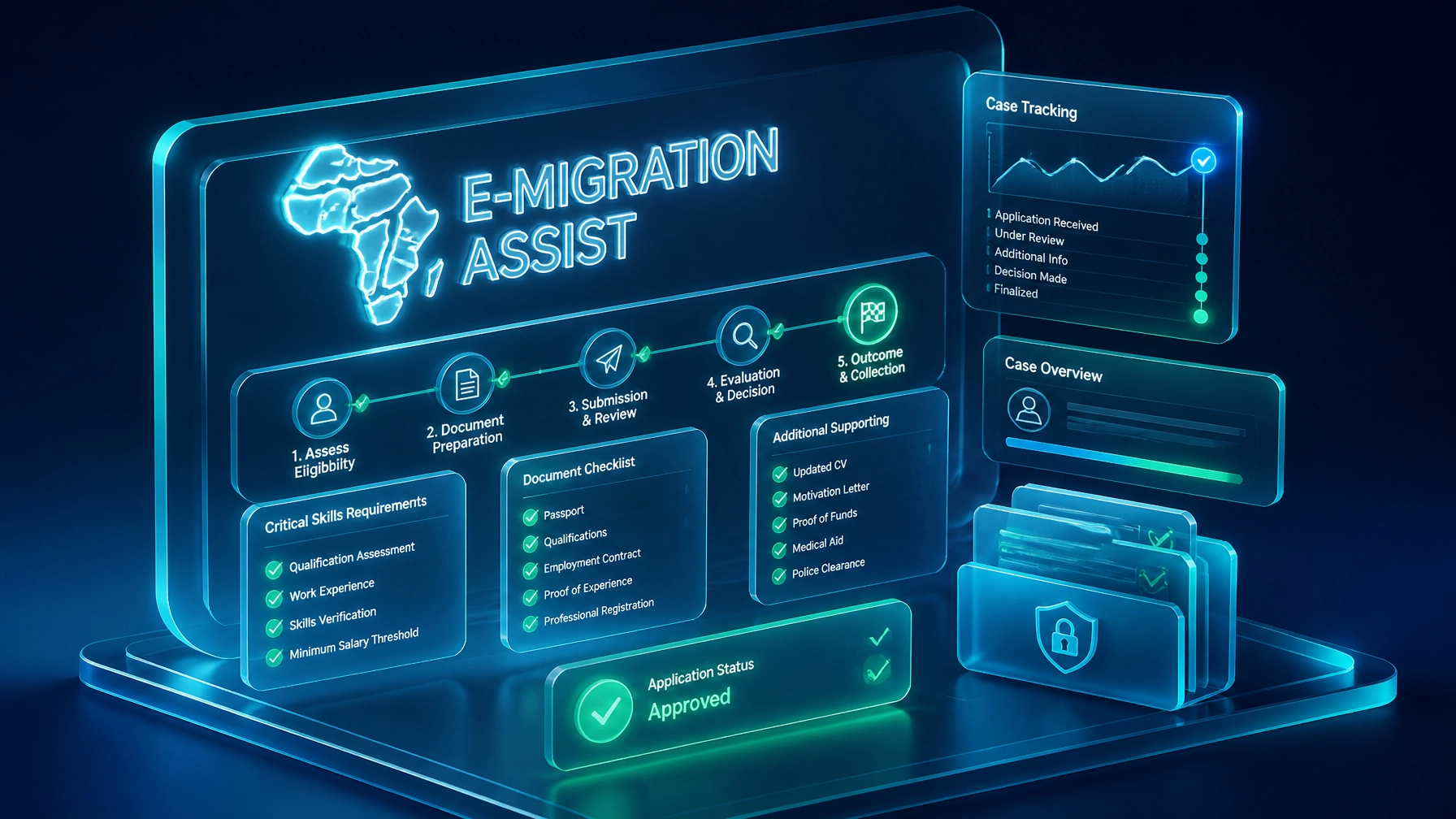
    E-Migration Assist is not an immigration consultancy. We are the infrastructure behind a more structured process. For individuals, that means guided clarity. For firms, that means a stronger system for the workflows they already run. Less admin. More control.


    Comparison: Remote Work Visa vs. Start-up Entrepreneur Visa

    As of 2026, the primary route for nomads is the Remote Work Visitor Visa. However, for those looking to build a local footprint, the Start-up Visa is the rising star on the horizon.

    Technology-focused comparison graphic for South Africa Remote Work Visa vs Start-up Visa requirements

    Feature Remote Work Visitor Visa (Digital Nomad) Start-up Entrepreneur Visa (Proposed)
    Primary Goal Lifestyle & Foreign Earnings Innovation & Local Growth
    Income Requirement ZAR 650,796+ Gross Per Annum Capital Investment / Points-Based
    Source of Funds 100% Foreign Employer/Clients Local/International Investment
    Duration Up to 36 Months Variable (Path to Residency)
    Local Hiring Prohibited Encouraged/Required

    For most travellers, the South Africa remote work visa is the correct entry point. It requires you to prove that you are not entering the South African labor market, but rather "exporting" your expertise while "importing" your foreign currency into the local economy.


    The R650k Threshold: Navigating the Financial Standard

    To maintain the integrity of the migration system, the DHA has set a clear financial benchmark. To qualify for the South Africa digital nomad visa, you must demonstrate a gross annual income of at least R650,796.

    Technology-focused infographic of Remote Work Visa numbers: income requirements and duration

    This is not a suggestion; it is a hard requirement evidenced by three months of foreign bank statements. This is where the process often becomes overwhelming. For individuals, the challenge is knowing what to upload and when. For firms, the challenge is keeping every case consistent across teams. Managing sensitive financial data, meeting DHA standards, and tracking document validity can quickly become disorganized.

    E-Migration Assist simplifies this through our Secure Document Handling portal. Instead of relying on insecure email attachments and scattered folders, you work inside a privacy-conscious infrastructure that supports structured uploads, review, and tracking. It strengthens the process for individual applicants and helps professional firms streamline the workflows they already manage.


    Why Digital Nomads Demand "Digital Certainty"

    Digital nomads are tech-native. They live in the cloud and manage their lives through apps. When they encounter the manual, paper-based legacy of immigration, it creates a friction that can derail a move.

    We call this the need for Digital Certainty.

    — Unpredictability: Not knowing if your documents are "expired" before they are even reviewed.
    — Complexity: Navigating the "Medical" and "Radiological" report requirements without guidance.
    — Anxiety: Wondering if the ZAR 650,000 threshold was calculated correctly against your home currency.

    • Clarity: A step-by-step requirements checklist that updates in real-time.
    • Certainty: Automated tracking that notifies you the moment your case status changes.
    • Compliance: Human-reviewed guidance that supports a decision-ready application before it reaches a DHA official.

    This is the positioning that matters. Not consultancy. Infrastructure. A supportive system for people applying on their own, and a scalable operational layer for firms handling multiple matters at once. Less friction. More structure.


    The Digital Nomad Journey: From Application to Arrival

    The process of moving to South Africa on a South Africa work permit (specifically the remote work category) involves four critical digital milestones.

    Technology-focused infographic showing the 4 stages of the digital nomad journey with E-Migration Assist

    1. Strategic Intake: Assessing your income and contract to ensure you meet the R650k gross salary requirement.
    2. Workflow Activation: Activating the specialized "Remote Work" track within our platform.
    3. Document Verification: Uploading PCCs (Police Clearance Certificates) and medicals for human review.
    4. Decision Logging: Archiving your visa outcome and tracking your stay duration for future renewals.

    The SARS Factor: Compliance is Your Only Strategy

    Living in South Africa for more than six months within a 36-month period triggers specific tax obligations. As emphasized by Dr. L. A. Schreiber, MP, Minister of Home Affairs, the visa is designed to be streamlined, but it does not exempt you from fiscal responsibility.

    Nomads who stay beyond 183 days must register with the South African Revenue Service (SARS). Failure to understand this intersection of immigration law and tax law can lead to significant financial risk.

    At E-Migration Assist, we treat compliance as the foundation of the process. We are not a consultancy. We provide the Case Management Infrastructure that helps individuals stay organized and helps professional firms run compliant, repeatable workflows at scale. For more on the risks of non-compliance, read our guide on The R100,000 Risk.


    Conclusion: Secure Your Process with Structure

    The choice between a South Africa remote work visa and any other category is a choice between two different life paths. For the employee or contractor with global clients, the remote work route is the definitive answer.

    However, the visa itself is just one part of the process. The real value lies in the system used to manage it. The old way is manual, fragmented, and difficult to control. The new way is centralized, structured, and built for visibility.

    E-Migration Assist is the supportive infrastructure layer behind that shift. For individuals, it creates clarity and confidence. For professional firms, it helps streamline existing workflows without losing control of compliance. Less admin. More control.

    Ready to streamline your workflow?
    Use our case management system to bring structure, tracking, and document control into your existing process.

    #DigitalNomad #RemoteWork #SouthAfricaVisa #NomadLife #WorkFromAnywhere #DHA #GlobalMobility #EMigrationAssist

  • 32 African Countries, One Visa Waiver: South Africa’s Continental Opening

    32 African Countries, One Visa Waiver: South Africa’s Continental Opening

    The landscape of African mobility has undergone a seismic shift. For decades, the movement of professional talent and business leaders across the continent was defined by friction: thick stacks of paperwork, weeks of waiting, and the persistent uncertainty of manual processing. Today, that narrative is being rewritten.

    South Africa has officially confirmed a visa-exemption list covering 32 African nations. This isn't just a policy update; it is a strategic opening of the continental gateway. By allowing citizens from key economic hubs like Nigeria, Kenya, Egypt, and Ghana to enter for short-term business and tourism without a prior visa application, South Africa is positioning itself as the central nervous system of the African Continental Free Trade Area (AfCFTA).

    At E-Migration Assist, we recognize that while the borders are opening, the need for precision has never been higher. As an infrastructure provider, we support both individuals and professional firms with the structure needed to manage immigration processes clearly and consistently. A waiver of the visa requirement does not mean a waiver of compliance.

    The Strategic Vision of Dr. Leon Schreiber, MP

    This transformation is led by Dr. Leon Schreiber, MP, Minister of Home Affairs. Since taking office, the Minister has been vocal about the link between immigration reform and economic growth. His administration has moved with deliberate speed to align South Africa’s Department of Home Affairs (DHA) with global best practices, prioritizing digital transformation over bureaucratic stagnation.

    The vision is clear: South Africa must attract investment, facilitate trade, and integrate with its neighbors. By removing the visa barrier for 32 African countries, Dr. Leon Schreiber, MP, is signaling to the world that South Africa is open for business. However, this increased flow of people requires a robust, high-tech infrastructure to manage the volume while ensuring national security and regulatory certainty.


    Problem vs. Solution: Navigating the Opening

    The shift from a restricted border to a visa-exempt environment brings both opportunity and risk.

    The Old Way: Manual Friction

    : Disorganized Documentation: Relying on physical files and email threads to prove business intent.
    : Application Anxiety: Not knowing if your entry will be challenged at the port of entry due to inconsistent paperwork.
    : Corporate Inefficiency: Global mobility managers manually tracking dozens of different regional requirements.
    : Compliance Gaps: Missing critical expiry dates or overstaying due to a lack of automated alerts.

    The New Way: Digital Certainty

    • Structured Workflows: Predefined pathways that help individuals and firms manage entry requirements with more clarity.
    • Centralized Control: A single system to monitor travel files, documents, and status updates in one place.
    • Automated Compliance: Infrastructure that flags risks and logs every decision for future audit trails.
    • Human-Reviewed Guidance: Technology-powered workflows supported by careful review to reduce avoidable errors.

    Infographic comparing the disorganized old manual way of travel with the new structured digital way.


    The 32-Country List: Who Benefits?

    The exemptions apply to a broad range of nations, facilitating a "no-border" feel for short-term stays (typically 30 to 90 days). The list includes:

    • Regional Powerhouses: Nigeria, Egypt, Kenya, Ethiopia.
    • SADC Partners: Botswana, Namibia, Zimbabwe, Zambia, Mozambique, Malawi.
    • West African Hubs: Ghana, Senegal, Ivory Coast.
    • North African Markets: Morocco, Tunisia, Algeria.

    For professionals and corporate mobility managers, this list represents a massive reduction in administrative overhead. If you are an engineering firm in Johannesburg bringing in consultants from Nairobi, or a tech startup in Lagos expanding to Cape Town, the path is now clearer.

    However, "visa-free" does not mean "requirement-free." Travellers must still present valid passports, proof of return, and, in many cases, specific business invitation letters that meet DHA standards. This is where E-Migration Assist’s structured workflows give individuals and professional firms a more reliable system for managing the process.


    AfCFTA and the Move Toward a Digital ETA

    The 32-country waiver is a critical step toward the broader goals of the African Continental Free Trade Area (AfCFTA). For trade in services to flourish, the people providing those services must be able to move.

    To manage this increased volume, South Africa is increasingly looking toward an Electronic Travel Authorisation (ETA) system. This digital layer acts as a filter, allowing the government to vet travellers before they reach the border.

    E-Migration Assist Digital Application Gateway showing the stages of a structured visa process.

    At E-Migration Assist, we provide the case management infrastructure that prepares you for this digital future. We do not position ourselves as a consultancy. We provide the powered system that helps individuals and professional firms bring more structure, consistency, and control to immigration workflows. Our platform standardizes the collection of sensitive documentation, ensuring that every traveller: whether they are from a visa-exempt country or not: has a professional, audit-ready profile.


    Privacy-First Infrastructure for Modern Firms

    For professional firms and law practices, managing the influx of African talent requires more than just a spreadsheet. For individuals, the process can feel just as overwhelming without a clear system. You need a privacy-first infrastructure that respects POPIA and international data standards while supporting existing workflows with more order and less admin.

    When you use the E-Migration Assist portal, you aren't just filling out forms. You are entering a secure ecosystem designed for high-stakes immigration:

    1. Secure Document Handling: Upload sensitive IDs and corporate certificates into a high-security vault.
    2. Decision Logging: Every step of the journey, from the initial assessment to the final entry stamp, is archived.
    3. Real-Time Tracking: No more "calling for updates." The case management dashboard gives you a live view of every file in your system.

    The E-Migration Assist case management dashboard showing real-time tracking of immigration cases.

    Conclusion: Lead with Clarity, Not Chaos

    The opening of South Africa's borders to 32 African nations is the most significant immigration event of the decade. It offers a competitive advantage to those who can move quickly and a massive risk to those who rely on outdated, manual processes.

    Don't leave your continental expansion to chance. Whether you are a professional firm managing a portfolio of clients or an individual navigating your own journey, the future of African mobility is digital, structured, and secure.

    Ready to streamline the way you already work?
    Use our case management system to streamline your existing workflows and bring more structure, visibility, and control to every immigration file.

    The E-Migration Assist secure login portal, your gateway to professional immigration infrastructure.

    #AfricaMobility #AfCFTA #VisaExemption #SouthAfrica #AfricanIntegration #BusinessTravel #TradeAfrica #EMigrationAssist

  • 53,000 Deportations and Counting: What the Immigration Crackdown Means for Employers

    53,000 Deportations and Counting: What the Immigration Crackdown Means for Employers

    The landscape of South African immigration has shifted from administrative delay to active enforcement. On 11 July 2026, the Inter-Ministerial Committee on Migration, chaired by Justice Minister Mmamoloko Kubayi, delivered a sobering report: 53,449 foreign nationals have been processed for deportation or repatriation in a span of just five weeks.

    This is not a temporary surge. It is the operational rollout of a Cabinet-approved strategy designed to standardize, track, and enforce migration laws with unprecedented technological precision. For employers, the era of "passive compliance" is over. If your organization relies on foreign talent, the risk profile of your workforce has fundamentally changed.

    The Five-Point Enforcement Plan: A High-Tech Net

    The current crackdown is governed by a strategic five-point plan approved by Cabinet in June 2026. This framework moves beyond simple border patrols and into the heart of the corporate environment.

    1. Workplace Inspections and Labour Audits: Large-scale, coordinated raids on businesses to verify the validity of every South Africa work permit.
    2. Dedicated Immigration Courts: Specialized courts in Durban, OR Tambo, and Lindela to fast-track deportation orders, removing the "administrative backlog" defense.
    3. Advanced Border Surveillance: Deployment of drones, ground sensors, and satellite monitoring to detect irregular crossings.
    4. Real-Time Travel Tracking: The launch of the Electronic Travel Authorisation (ETA) system, allowing the state to monitor every foreign national's status in real time.
    5. Legislative Reform: Tightening documentation requirements and curbing permit abuse through strict regional cooperation.

    : Disorganized paper files
    : Expired permits hidden in spreadsheets
    : Unmonitored visa conditions
    : Vulnerability to sudden labour audits

    • Centralized digital tracking
    • Automated expiry alerts
    • Human-reviewed document accuracy
    • Instant compliance reporting

    Escalating Enforcement Under Dr. L. A. Schreiber, MP

    The modernization of this enforcement net is led by Dr. L. A. Schreiber, MP, Minister of Home Affairs. His administration has overseen a cumulative 46% increase in deportations over the last two financial years. By integrating biometric verification tools and body camera technology into "Operation New Broom," the Department of Home Affairs (DHA) has removed the ambiguity that previously allowed irregular migration to go undetected.

    Chart showing the 46% increase in deportation trends

    Dr. L. A. Schreiber, MP, has been clear: the state's priority is a high-tech, high-efficiency model where "every foreigner entering the country is matched and, if necessary, located for enforcement." For a business owner, this means that an undocumented worker is no longer just a regulatory oversight: they are a tracked data point in a national surveillance system.

    The Liability Crisis: Why Employers are the New Front Line

    Under the current crackdown, the Inter-Ministerial Committee has prioritized workplace inspections as a primary tool for "migration management." The burden of proof has shifted entirely to the employer.

    If a DHA inspector arrives at your office today, can you prove: within minutes: that every foreign employee holds a valid visa and is performing duties strictly within their permit's conditions?

    The risks of failure are severe:
    : Legal Liability: Substantial fines and potential criminal charges for "knowingly" or even negligently employing undocumented individuals.
    : Operational Disruption: Immediate removal of key staff members, leading to project delays and reputational damage.
    : Future Bans: Under the new deterrence model, individuals deported are often banned from legal re-entry, permanently stripping your business of that talent.

    The Problem: The "Old Way" is a Liability

    Most firms still manage their South Africa work permit portfolios using manual systems. This is the "Old Way," and it is failing under the pressure of the 2026 enforcement environment.

    : Manual Spreadsheets: Human error leads to missed expiry dates and "ghost" permits.
    : Email-Based Document Handling: Sensitive passports and visas are scattered across unsecured inboxes.
    : Lack of Audit Trails: No centralized log of when a decision was made or who reviewed the documentation.
    : Reactive Strategy: Waiting for the DHA to send a notice before checking compliance.

    Infographic comparing Manual Risk vs Structured Compliance

    The Solution: Immigration Case Management Software

    To survive a "Five-Point Plan" audit, your business requires more than a consultant; it requires a specialized immigration case management software infrastructure. This is where E-Migration Assist transforms your risk into a controlled, professional workflow.

    Our platform was designed specifically for the high-enforcement landscape described by the Inter-Ministerial Committee. We provide the "New Way" of managing migration:

    1. Structured Workflows per Visa Type
    We don't guess. Our system uses predefined, intelligent pathways for every visa category, ensuring that every submission is technically sound and fully compliant with the latest DHA directives.

    2. Secure Document Handling & Privacy-First Infrastructure
    Move your sensitive documentation out of emails and into a secure, POPIA-conscious portal. We provide a central repository for all employee records, making audit preparation a matter of a few clicks.

    3. Tracking and Decision Logging
    Every step of an application is archived. This "Decision Logging" is your ultimate defense during a labour audit, proving that your firm exercised due diligence at every stage of the hiring process.

    4. Human-Reviewed Guidance
    Technology alone isn't enough. Every case on our platform is backed by human-reviewed expertise to ensure that the "tech" matches the "legal reality" of South African immigration law.

    E-Migration Assist Case Management Dashboard

    Conclusion: Control the Narrative Before the Audit

    With 53,000 deportations in five weeks, the message from the South African government is loud and clear: enforcement is the new standard. Your business cannot afford to be part of the next statistic.

    By moving your immigration processes to the E-Migration Assist platform, you transition from a state of "overwhelming risk" to one of "structured control." We provide the infrastructure you need to ensure your foreign talent is secure, your business is compliant, and your operations are ready for whatever comes next.

    Stop managing by chance. Start managing by system.

    Secure your business profile today with a free assessment.

    #SouthAfricaImmigration #Compliance #Deportation #DHA #EmployerLiability #ImmigrationTech #AfricaMobility #EMigrationAssist

  • The Points-Based Revolution: How South Africa’s New Skilled Worker Visa Will Work

    The Points-Based Revolution: How South Africa’s New Skilled Worker Visa Will Work

    For decades, the South African immigration landscape was defined by rigid categories, manual delays, and a binary "yes or no" system that often failed to account for the nuance of global talent. In 2026, that landscape has been fundamentally altered. Following the Cabinet-approved Revised White Paper on Citizenship, Immigration and Refugee Protection, South Africa has transitioned to a modern, merit-based framework.

    The centerpiece of this reform is the new Skilled Worker Visa. By merging the previous Critical Skills and General Work visas into a single, unified pathway, the government is signaling a shift toward efficiency and economic pragmatism. At E-Migration Assist, we see that this "Points-Based Revolution" represents the most significant change to the South Africa work permit system in a generation.

    As an infrastructure provider, not a consultancy, E-Migration Assist gives both individuals and professional firms the structured system needed to move through change with more clarity and control.

    The Problem: The Legacy of Administrative Labyrinth

    Until now, applicants and professional firms faced a system characterized by:
    : Ambiguous Criteria: Lack of clarity on how "critical" a skill truly was in a shifting economy.
    : Manual Friction: A reliance on paper-heavy processes that invited human error and delays.
    : Discretionary Risk: High levels of subjective decision-making that created uncertainty for investors.
    : Fragmented Workflows: Separate categories that forced applicants into ill-fitting boxes.

    The Solution: A Merit-Based Points System (PBS)

    The new system replaces subjective assessment with objective data. Under the guidance of Dr. Leon Schreiber, MP, Minister of Home Affairs, the Department of Home Affairs (DHA) has implemented a Points-Based System (PBS) designed to attract the high-skill labor necessary for national growth.

    A policy-and-technology themed visual showing digital scoring interfaces, structured workflow elements, and a South Africa-focused immigration reform environment with the E-Migration Assist Africa silhouette logo.

    The PBS is a definitive answer to the inefficiencies of the past. It offers:

    • Predictable Outcomes: Applicants can calculate their viability before even beginning the process.
    • Economic Alignment: Criteria are directly linked to South Africa’s real-time economic needs.
    • Digital Speed: Automated scoring allows for faster throughput and reduced backlogs.
    • Transparent Tracking: A centralized logic that removes the "black box" of visa processing.

    Decoding the Points Criteria

    The success of a Critical skills visa South Africa application now rests on four primary pillars. To qualify for the new Skilled Worker Visa, applicants must meet a minimum threshold (currently proposed at 80 points for temporary residence and 100 points for permanent residency).

    1. Education and Qualifications

    Your academic background is now your strongest asset. Degrees from internationally recognized institutions, particularly in STEM (Science, Technology, Engineering, and Mathematics) fields, carry the highest weight.
    : Old Way: Searching for a specific job title on a static Critical Skills list.

    • New Way: Earning points based on the level of NQF-aligned qualification and its relevance to emerging industries.

    2. Income Thresholds

    The new system values economic contribution. High-income earners who contribute significantly to the tax base and local economy are prioritized. This ensures that the immigration system acts as a catalyst for investment rather than a drain on infrastructure.

    3. Age and Career Longevity

    There is a strategic focus on professionals in their "prime" productive years. Younger professionals with high-growth potential receive weighted points, reflecting the vision of Dr. Leon Schreiber, MP, Minister of Home Affairs to build a sustainable, long-term workforce.

    4. Skills Alignment

    Points are awarded for experience in sectors identified as critical for South Africa's 2026-2030 development goals. This includes green energy, fintech, and advanced manufacturing.

    A modern lab-tech workspace with qualification and data motifs, symbolizing the high-skill industries targeted by South Africa's points-based visa system.

    The Vision of Dr. Leon Schreiber, MP: Attracting Investment

    The South Africa immigration reform 2026 is not just about border control; it is about economic competition. Dr. Leon Schreiber, MP, Minister of Home Affairs, has been vocal about the need for South Africa to compete for the world’s best talent.

    In the Minister's words, the goal is to make South Africa a "magnet for skilled professionals." By removing the "administrative tax" of a slow visa process, the government aims to unlock billions in potential investment. The points-based system is the engine of this new strategy, ensuring that those who can grow the economy are given a clear, structured pathway to do so.

    Why Tech and Automation are Non-Negotiable

    While the points-based system is more logical, it is also more complex. Calculating points, verifying international qualifications, and ensuring alignment with the latest sectoral needs requires more than just a spreadsheet. It requires a specialized case management infrastructure.

    A people-free immigration case management environment with workflow screens, secure document handling, tracking tools, and compliance structure.

    At E-Migration Assist, we have built the "powered" foundation necessary to support this transition. We are an infrastructure provider for immigration case management, built to help individuals and professional firms work in a more structured way. Our platform provides:
    : Automated Requirements Checklists: We replace guesswork with a step-by-step pathway based on the case profile.
    : Secure Document Handling: A privacy-first portal keeps sensitive qualifications and financial data protected.
    : Human-Reviewed Guidance: Our system is intelligent, and our reviews add an extra layer of accuracy so the workflow stays complete and compliant.

    Moving from Manual to Managed

    The transition to a points-based system marks the end of the era of "manual case confusion." For professional firms and corporate mobility managers, the "old way" of managing applications through fragmented emails and disorganized spreadsheets is no longer viable.

    The E-Migration Assist case management dashboard in a clean office environment, showing workflows, tracking, decision logging, and secure document handling.

    Our Case Management Dashboard allows you to:

    • Centralize Control: Manage multiple applications across different sectors from a single interface.
    • Monitor Progress: Real-time tracking of case status ensures you are never in the dark.
    • Archive Results: Detailed decision logging provides a permanent record of compliance and success.

    Total Transformation: Less Admin, More Control

    The South Africa work permit process is being transformed from a burden into a competitive advantage. The points-based system provides the structure; E-Migration Assist provides the system.

    Whether you are an individual professional preparing your own application or a firm managing a portfolio of cases, the goal is the same: clarity, certainty, and control.

    Don't manage complex immigration workflows through scattered emails and spreadsheets. Use a system built to bring structure to the process.

    Use our case management system to streamline your existing workflows and move forward with more control.

    #SouthAfricaVisa #WorkPermit #SkilledWorkerVisa #ImmigrationReform #GlobalMobility #DHA #FutureOfWork #EMigrationAssist

  • Visa Amnesty Extended to 2027: What the Concession Means for Overstayers

    Visa Amnesty Extended to 2027: What the Concession Means for Overstayers

    For thousands of foreign nationals, corporate mobility managers, and immigration practitioners, the looming threat of "undesirability" has been a constant source of anxiety. The South Africa visa backlog has historically forced applicants into a corner: stay and risk becoming an illegal overstayer, or leave and risk a multi-year ban from the Republic.

    That cycle of uncertainty has finally been broken.

    Dr. Leon Schreiber, MP, Minister of Home Affairs, has formally issued Immigration Directive 7 of 2026, extending the temporary visa concession until June 30, 2027. This decisive action provides a massive relief for those caught in the administrative gears of the Department of Home Affairs (DHA). However, this "amnesty" is not a free pass: it is a conditional stay of execution that requires absolute precision in document tracking and compliance.

    The Problem: The Cost of Administrative Limbo

    Before this directive, the "old way" of managing immigration was defined by a lack of control and escalating risks.

    : Expired Visas: Living day-to-day on an expired stamp with no clarity on when a renewal would be granted.
    : Travel Bans: The fear of being declared "undesirable" at the airport for an overstay caused by DHA delays.
    : Manual Tracking: Relying on loose paper receipts and frantic email threads to prove legality.
    : Professional Paralysis: Employers unable to confirm the legal status of key staff due to pending outcomes.

    The mental and professional toll was overwhelming. Without a centralized system to manage the South Africa visa backlog, individuals were left to navigate a chaotic regulatory landscape alone.

    The Solution: A Structured Pathway to 2027

    The extension to June 30, 2027, represents a definitive solution to the backlog crisis. It transforms the "overstay" from a legal threat into a managed administrative state, provided you meet the strict criteria set out by the Minister.

    Secure digital dashboard displaying a visa application receipt archive, structured checklist, and status tracker in a modern desk environment.

    Who is Covered Under the New Concession?

    The directive specifically protects those who were legally admitted to the country and have pending applications lodged through VFS Global. This includes:

    1. Pending Waiver Applications: If you applied for a waiver that was pending as of March 30, 2026, your current visa status is protected until mid-2027.
    2. Pending Long-Term Visa Applications: Holders of section 11(1)(b) through section 22 visas who have submitted renewal or new long-term applications are granted an automatic extension.
    3. Pending Appeals: If you are appealing a negative decision on a long-term visa or a permanent residence application, you are legally permitted to remain in South Africa while the appeal is processed.
    • Legal Certainty: A guaranteed extension of your current visa conditions.
    • Travel Freedom: The ability to depart and re-enter South Africa without being declared undesirable (provided you carry a verifiable VFS receipt).
    • Business Continuity: Companies can keep their international talent on the ground legally while the system clears the backlog.

    The Mandate of the "Verifiable Receipt"

    While the concession provides relief, it places a heavy burden of proof on the applicant. The directive is clear: you must hold a valid, verifiable receipt for your application. In an environment where paper receipts are easily lost or damaged, this requirement creates a new technical challenge.

    This is where E-Migration Assist shifts the paradigm. We are not a consultancy. We are a privacy-first, tech-powered infrastructure provider built to support both individuals and professional firms through the 2027 horizon.

    The New Way: Digital Certainty

    • Structured Workflows: Predefined pathways for waivers and appeals help individuals and firms keep every step visible, organized, and on track through 2027.
    • Tracking and Decision Logging: A centralized system to archive VFS receipts and monitor case status in one place.
    • Privacy-First Infrastructure: Securely store sensitive identity documents in a portal built for high-trust document handling.
    • Human-Reviewed Guidance: Supportive review layers help you confirm that your pending application aligns with the concession requirements, without replacing your existing process.

    Modern airport lounge environment with a laptop showing an organized immigration case tracking dashboard and travel-readiness workflow.

    Navigating South Africa Visa Requirements in 2026

    The extension provided by Dr. Leon Schreiber, MP, Minister of Home Affairs, is a bridge to a more modern, efficient immigration system. However, a bridge is only useful if you know how to cross it.

    To remain compliant under the new directive, applicants must ensure their South Africa visa requirements are perfectly met. A pending application that is rejected due to a "document error" could immediately strip you of the concession's protection, leaving you vulnerable to deportation or a ban.

    : Risk: Submitting an incomplete application and thinking you are protected by the amnesty.

    • Control: Using E-Migration Assist’s Requirements Checklists to ensure your submission is bulletproof before it hits the VFS desk.

    : Risk: Losing track of an appeal deadline while waiting for the backlog to clear.

    • Control: Automated Tracking and Decision Logging that keeps your case history visible and actionable.

    Total Transformation: From Anxiety to Authority

    The extension of the visa amnesty to 2027 is a rare window of opportunity. It allows the Department of Home Affairs to modernize its systems while allowing you to maintain your life and career in South Africa.

    By moving away from spreadsheets and physical files toward a centralized, intelligent case management system, you gain more than just a visa outcome: you gain structure, visibility, and control. Whether you are an individual managing your own application or a professional firm managing multiple matters, the goal is the same: less admin, more control.

    Don't leave your legal status to chance in the midst of a historic backlog. Support your existing process with a system that keeps every receipt, requirement, and status update in one place.

    Need a better way to manage concession-related cases?

    Use Our Case Management System to Streamline Your Workflow

    Wide shot of a modern legal-tech office environment with monitors showing '2027 Visa Concession: Compliance Workflow' and structured case dashboards.

    #SouthAfricaVisa #VisaAmnesty #DHA #ImmigrationCompliance #VisaBacklog #SouthAfrica #EMigrationAssist #GlobalMobility

  • 203,000 Applications in Months: How the ETA Is Reshaping South Africa’s Visa System

    203,000 Applications in Months: How the ETA Is Reshaping South Africa’s Visa System

    The landscape of South African migration is undergoing a radical shift from manual friction to digital precision. For years, the narrative surrounding the Department of Home Affairs was defined by backlogs and opaque processes. Today, that narrative has been replaced by a data-driven reality.

    Speaking at the recent Xpatweb Annual Global Mobility Conference, Dr. Leon Schreiber, MP, Minister of Home Affairs, unveiled the staggering impact of the new Electronic Travel Authorisation (ETA) flagship reform. The system has moved from a theoretical digital promise to a high-capacity engine of growth, processing over 203,000 applications in just a few short months.

    At E-Migration Assist, we recognize this as more than just a government update; it is a foundational change in how global mobility is managed. As an infrastructure provider for professional firms and individuals, we see the same need on both sides: less confusion, less admin, and more control. The message is clear: the age of "waiting and hoping" is over. The age of structure, clarity, and control has arrived.


    The New Standard: Security Powered by Automation

    The sheer volume of processed applications is only half the story. The true victory for the new system lies in its ability to separate legitimate global talent from security risks without human bottlenecks.

    The ETA system utilizes advanced machine learning and biometric verification to vet every applicant against domestic and international databases in real-time. This isn't just about speed; it's about integrity. During his keynote, Dr. Leon Schreiber, MP, Minister of Home Affairs, confirmed that the system’s automated risk analysis successfully identified and rejected 5,700 fraudulent applications.

    The Old Way vs. The New Way

    : Manual Submission: Relying on paper documents that can be lost, forged, or delayed for months.
    : Opaque Status: Zero visibility into where an application sits in the queue, leading to business disruption.
    : Human Error: Manual data entry and subjective risk assessment leading to inconsistent outcomes.

    • Automated Risk Engine: Machine learning identifies 40+ document parameters to ensure absolute authenticity.
    • Digital Certainty: Instant feedback on application status, allowing firms to plan their mobility pipelines with precision.
    • Biometric Integrity: Facial recognition matches applicants to their documentation, closing the door on identity fraud.

    Technology interface representing automated risk analysis and machine learning


    The 90-Day Extension: Flexibility at Your Fingertips

    One of the most significant pain points for travellers in South Africa has historically been the visitor visa extension process. Previously, this required a physical visit to a VFS office and weeks of manual processing.

    The Department of Home Affairs has now introduced a specialized digital extension module. This module allows visitors to apply for an additional 90 days entirely online.

    : Previous Frustration: Losing a full day of productivity to visit a processing center for a simple extension.
    : Risk of Overstay: Manual delays often meant applicants became "undesirable" simply because the system was slow.

    • Instant Processing: Digital submission through the ETA portal for 90-day extensions.
    • Compliance by Design: Automated tracking ensures you are notified well before your status expires.

    This shift ensures that South Africa remains a competitive destination for "Digital Nomads" and business consultants who require the flexibility to extend their stay without administrative nightmares.

    Digital visitor visa extension workflow dashboard in a modern workspace


    Structured Workflows: Why Tech Needs a Human Review

    While the government’s ETA system provides the "highway," your internal case management is the "vehicle." Even with a digital system, the risk of a rejection: like the 5,700 flagged by the Minister: remains high if your documentation is not structured correctly from the start.

    This is where E-Migration Assist fits in. We are not a consultancy. We are a specialized infrastructure provider built to support professional firms and individuals with a more structured way to manage South African immigration workflows.

    Our structured workflows give users a powered system for organizing evidence, reviewing requirements, tracking progress, and maintaining control before a case reaches the government’s automated risk engine.

    Why Order Matters in 2026:

    • Consistency: Predefined pathways for each visa type to prevent missed steps.
    • Privacy: Secure, encrypted handling of sensitive documents.
    • Tracking: A centralized dashboard to monitor case status and archive decision logs.

    The ETA system is designed to reward accuracy. A single mismatched detail can trigger an automated rejection. Our platform helps you bring structure to each case, reduce workflow gaps, and move forward with more confidence.

    Immigration case management dashboard and structured workflow system


    Conclusion: A Total Transformation of Mobility

    The statistics shared by Dr. Leon Schreiber, MP, Minister of Home Affairs, prove that South Africa is serious about becoming a global leader in legal tech and immigration efficiency. The processing of 203,000 applications is proof of a system that works.

    However, a faster system demands higher precision from the applicant. You can no longer rely on the "organized chaos" of spreadsheets and emails. You need a system that matches the sophistication of the ETA.

    Less admin. More control. Total compliance.

    Whether you are an individual planning your next 90 days or a professional firm managing multiple matters, the foundation of success is the same: Digital Certainty.

    If your current process feels overwhelming, disorganized, or too manual, the answer is not more email. It is better infrastructure. Use our case management system to streamline your existing workflows with more structure, visibility, and control.

    #SouthAfricaVisa #ETA #HomeAffairs #ImmigrationTech #GlobalMobility #DigitalTransformation #EMigrationAssist #VisaTracking

  • Trusted Employer Scheme Phase II: Who Qualifies for the Visa Fast Lane?

    Trusted Employer Scheme Phase II: Who Qualifies for the Visa Fast Lane?

    For years, corporate South Africa has voiced a single, loud frustration: the "visa bottleneck." Recruiting global talent was often a gamble against time, backlogs, and opaque processing. On 20 July 2026, that narrative shifted.

    Dr. Leon Schreiber, Minister of Home Affairs, officially gazetted the launch of the Trusted Employer Scheme (TES) Phase II (Government Gazette No. 55036). This isn’t just a policy update; it is a fundamental redesign of how South Africa handles high-value skills and investment.

    By shifting from a "gatekeeper" model to a "trusted partner" model, the Department of Home Affairs is finally offering a fast lane for companies that prove they are compliant, invested, and strategic to the nation’s growth.

    The Problem: Why the "Old Way" is Obsolete

    Until now, most employers faced a manual, unpredictable journey for every single South Africa work permit.

    : Months-long wait times for even the most basic critical skills visas.
    : Inconsistent document requirements that vary between VFS offices and embassies.
    : Lost revenue as international hires wait overseas while projects stall.
    : Administrative fatigue caused by tracking dozens of applications via spreadsheets and emails.
    : Compliance risks due to a lack of centralized oversight and decision logging.

    In this environment, "luck" became a strategy. That is no longer acceptable for a modern economy.

    The Solution: The TES Phase II "Fast Lane"

    Phase II of the Trusted Employer Scheme provides a structured, predictable, and prioritized pathway for accredited corporations. It moves beyond the 65-80 companies approved in Phase I and opens the door to a wider range of strategic sectors.

    • Priority Processing: Visa applications for TES members are moved to the front of the queue.
    • Reduced Red Tape: Significant reductions in the documents required for individual employees.
    • Immediate Talent Access: Requirements like SAQA certificates or professional body registrations can often be streamlined for accredited firms.
    • Predictability: Outcomes are standardized, removing the "black box" of traditional processing.
    • Digital Integration: The scheme is part of the "Home Affairs @ home" vision, moving toward a fully digital Critical skills visa South Africa process via the ETA platform.

    Hands of a professional organizing documents and using a digital workflow to manage visa applications.

    Who Qualifies? The Three Pathways

    Membership isn't guaranteed. To qualify for the fast lane, companies must submit an Expression of Interest (EOI) before 4 September 2026. Selection is based on an interdepartmental audit by Home Affairs, Employment & Labour, and Trade Industry & Competition.

    To be considered, your company must score at least 80 out of 100 points in one of these three distinct pathways:

    1. South African-Based Operations

    This pathway is for established companies already operating in South Africa.

    • Focus: Meaningful investment and a workforce primarily composed of South African citizens/permanent residents.
    • Requirements: Proven investment in local skills development and operations within priority economic sectors.

    2. Regional or Global Headquarters

    Are you looking to move your regional hub to Johannesburg or Cape Town? This pathway is designed for you.

    • Focus: Attracting multinational firms to use South Africa as their base for African operations.
    • Requirements: Demonstration of the headquarters' scale and the long-term economic impact of the move.

    3. Synthetic Financial Centres

    A specialized pathway for high-value entities in the financial services sector.

    • Focus: Enhancing South Africa's status as a global financial hub.
    • Requirements: Specific financial sector compliance and strategic value metrics.

    The Deadline: 4 September 2026

    The window is tight. Expressions of Interest close on 4 September 2026. Once the window closes, the interdepartmental committee will review all submissions. Outcomes are expected by 4 October 2026 (30 working days post-closing).

    An immigration professional using a tablet to monitor structured workflows and case compliance.

    Why Structure Matters in the TES Era

    Being a "Trusted Employer" comes with a high burden of responsibility. The Department of Home Affairs grants you speed, but in return, they expect flawless compliance. You cannot manage a TES accreditation with spreadsheets.

    This is where immigration case management software becomes a necessity rather than a luxury.

    At E-Migration Assist, we position ourselves as an infrastructure provider for the "new way" of working, not a consultancy. Our platform supports both individual applicants and professional firms with the structure needed for the rigour of the Trusted Employer Scheme:

    • Structured Workflows: Predefined pathways that mirror the exact requirements of TES Phase II.
    • Privacy-First Infrastructure: Secure handling of sensitive employee data, ensuring POPIA compliance.
    • Tracking and Decision Logging: A permanent digital audit trail for every application, crucial for maintaining your "Trusted" status.
    • Human-Reviewed Guidance: Supportive, human-reviewed checks that help users work through requirements with more clarity and control.

    The E-Migration Assist dashboard showing real-time case tracking and status updates.

    Transitioning from Chaos to Control

    The shift to TES Phase II represents a total transformation. It moves your immigration strategy from a reactive "firefighting" mode to a proactive "growth-oriented" system.

    : Old Way: Manual, disorganized, spreadsheet-heavy, and high-risk.

    • New Way: Automated, centralized, intelligent, and scalable.

    By leveraging the right technology and the new regulatory pathways provided by Dr. Leon Schreiber, Minister of Home Affairs, your organization can finally turn immigration from a bottleneck into a competitive advantage.

    Are You Ready for Phase II?

    The 4 September deadline is approaching quickly. Whether you are a global employer, a law firm managing corporate clients, or a relocation company, you need to know exactly where you stand before submitting your EOI.

    Organized digital folders representing secure case management for South African visa applications.

    Use a Structured System to Streamline Your Workflow
    We invite individual travellers, law firms, immigration consultancy firms, relocation companies, travel agencies, and global employers to take the next step toward more structure and less admin.

    If you need a better way to manage immigration matters, visa/permit compliance, documents, and case progress, use our case management system to streamline your existing workflows with more clarity and control.

    Start Your Free Assessment at E-Migration Assist

    More structure. Less admin. Better workflow control.

    #SouthAfricaVisa #TrustedEmployerScheme #CriticalSkillsVisa #ImmigrationTech #HomeAffairs #GlobalMobility #WorkPermitSA #EMigrationAssist

  • Medical Reports No Longer Required? Here’s What South Africa’s Latest Visa Directive Means for You

    Medical Reports No Longer Required? Here’s What South Africa’s Latest Visa Directive Means for You

    Navigating South African immigration just became significantly more efficient. On July 8, 2026, Minister of Home Affairs Dr. L.A. Schreiber signed Ministerial Immigration Directive No. 10 of 2026. Published in the Government Gazette on July 17, 2026, this landmark decision introduces a blanket waiver for medical reports.

    For years, the medical report (Form BI-811) was a mandatory hurdle. It required time, doctor visits, and additional costs. Now, the landscape has shifted. If you are applying for a South Africa visa or permanent residency, the rules have changed in your favor.


    The Old Way: Manual Delays and Medical Hurdles

    Until this directive, the medical report was a non-negotiable component of nearly every application. This requirement created consistent friction for both individual travellers and professional firms.

    : Financial Strain: High costs for private medical examinations and certifications.
    : Logistical Barriers: Difficulty scheduling appointments within tight application windows.
    : Administrative Bloat: Extra physical paperwork to track, scan, and submit.
    : Processing Friction: Applications delayed or rejected due to minor clerical errors on the medical form.
    : Inconsistency: Varying requirements between different VFS centers and foreign missions.

    The manual process was disorganized and overwhelming. It turned a health check into a bureaucratic bottleneck.


    The New Way: Structural Efficiency and Blanket Waivers

    Directive No. 10 of 2026 provides a definitive answer to these inefficiencies. By exercising powers under Section 31(2)(c) of the Immigration Act, the Minister has simplified the path to South Africa.

    An abstract legal-tech environment showing automated compliance clearance and layered digital workflows, with subtle E-Migration Assist Africa silhouette branding and no people.

    • Blanket Waiver: No individual waiver application is required; the benefit is automatic.
    • Broad Application: Covers all temporary residence visas and permanent residence permit applications.
    • Global Scope: Applies to applications lodged inside South Africa and at missions abroad.
    • Retroactive Relief: Valid for all future applications and those currently pending adjudication.
    • Reduced Costs: Immediate elimination of doctor fees and medical certificate expenses.

    This shift represents a move toward a more intelligent, modern immigration system. It removes a layer of "manual case confusion" and replaces it with clarity.


    Understanding the Specifics: Who Benefits?

    The directive specifically waives the requirements in subregulations 9(1)(c) and 23(1)(f) of the Immigration Regulations. Here is exactly what that means for different stakeholders:

    For Individual Travellers

    Whether you are applying for a South Africa work permit or a study visa, you no longer need to visit a doctor for the BI-811 report. This applies to your initial application and any pending renewals. You gain immediate control over your timeline and budget.

    For Permanent Residency Applicants

    The waiver is a major win for those seeking South Africa permanent residency. Historically, PR applications involve the most intense documentation. Removing the medical report lightens the load and accelerates the preparation phase.

    For Corporate Mobility and Legal Professionals

    Managing multiple cases is now simpler. Immigration practitioners and law firms can remove one of the most common "pending" items from their checklists. This allows for faster submission cycles and more predictable workflows for corporate clients.


    The Challenge: Managing Policy Shifts in Real-Time

    While a waiver sounds simple, the reality of South African immigration remains complex. Policy updates can be sudden. Information from different sources can be conflicting.

    A structured technology scene showing paper-based admin replaced by centralized digital case management dashboards and secure workflow systems, with subtle E-Migration Assist Africa silhouette branding and no people.

    : Information Overload: Keeping track of which directives are active vs. withdrawn.
    : Adjudication Risks: Ensuring VFS officials are aware of the latest Gazette updates.
    : Workflow Disruption: Updating internal firm checklists to reflect new South Africa visa requirements.
    : Compliance Gaps: Forgetting to apply the waiver to pending cases, leading to unnecessary work.

    Without a centralized system, even a positive change like a waiver can cause confusion.


    The Solution: E-Migration Assist Infrastructure

    E-Migration Assist provides the structured case management infrastructure that helps individuals and professional firms stay organised as requirements change. We are not a consultancy. We are the system behind a clearer, more controlled immigration process.

    A secure case management platform environment showing workflow modules, audit trails, document handling, and structured immigration operations, with prominent E-Migration Assist Africa silhouette branding and no people.

    • Structured Workflows: Use predefined case pathways that reflect current South African immigration requirements.
    • Requirements Checklists: Keep every case aligned with the latest directive changes, including waivers like No. 10 of 2026.
    • Decision Logging: Maintain a clear audit trail across submissions, status changes, and case outcomes.
    • Secure Document Handling: Centralise sensitive files in a privacy-first portal built for controlled collaboration.
    • Support for Individuals and Firms: Give travellers more clarity and give professional teams more consistency across active matters.

    Total Transformation: Less admin. More structure. More control.


    Ready to Navigate the New Requirements?

    The waiver of medical reports is a significant step toward a more accessible South Africa. However, the rest of the application remains rigorous. Don't leave your process to scattered emails, manual trackers, or outdated spreadsheets.

    Use a structured system that supports the workflow you already have. Whether you are an individual who needs more clarity or a professional firm that needs more consistency, E-Migration Assist works as a supportive partner through infrastructure built for control.

    Streamline Your Existing Workflow with E-Migration Assist.
    Explore our case management system →

    #SouthAfricaVisa #ImmigrationSA #DHA #VisaUpdate #GlobalMobility #LegalTech #WorkPermitSA #PermanentResidency #EMigrationAssist

  • Structured Critical Skills Visa Preparation for South Africa, Not Manual Case Confusion

    Structured Critical Skills Visa Preparation for South Africa, Not Manual Case Confusion

    Preparing a South Africa Critical Skills Visa can feel overwhelming when the process lives across emails, PDFs, and scattered notes.

    That creates risk for everyone involved.

    — Travellers can miss a required step.
    — Mobility teams can lose time across multiple cases.
    — Legal practitioners can end up reviewing incomplete files.

    The better approach is structure.

    From a global mobility perspective, a visa case needs predictable movement from assessment to submission.
    From a legal immigration process perspective, every requirement must be supported by the right evidence.
    From a technology and case management perspective, the file should live in one controlled system.

    At E-Migration Assist, we focus on practical control. We replace fragmented admin with guided workflows, secure document handling, and clear tracking.

    Here are seven common mistakes in Critical Skills Visa preparation, and a more structured way to handle each one.


    1. Using the Wrong Occupation Classification

    A common problem starts with role matching. A job title on its own is not enough. The occupation description, duties, and supporting documents all need to line up.

    : The Problem: A role is classified too broadly or mapped to the wrong occupation category. That creates confusion early and weakens the full case.

    • The Solution: Our structured workflows help firms and applicants map the role properly from the start. That gives the case a cleaner legal basis, better document consistency, and more control for mobility teams.

    2. Starting Qualification Review Too Late

    Qualification review is often one of the slower parts of the process. Many applicants wait until a job offer is confirmed before they start.

    A high-fidelity 3D digital illustration of a translucent blue and emerald document pipeline with stacked secure folders, upload arrows, validation checkmarks, and a clean status bar.

    : The Problem: A delayed qualification review can hold up the rest of the file. Medicals, planning dates, and internal timelines can all be pushed out.

    • The Solution: Our Requirements Checklists bring forward high-latency tasks at the start of the case. That helps travellers move earlier, helps legal teams plan better, and helps case managers keep the workflow on schedule.

    3. Missing the Right Professional Registration

    Some occupations require registration with the relevant professional body before the visa file is complete. This step is often misunderstood or left too late.

    : The Problem: The applicant engages the wrong body, or submits before registration is ready. That creates avoidable delays and extra review work.

    • The Solution: E-Migration Assist provides human-reviewed guidance to confirm what type of registration applies to the occupation. That supports a cleaner legal process, reduces back-and-forth, and keeps the case structure intact.

    4. Submitting Weak Experience Evidence

    Employment letters often create problems. They may confirm dates of work but fail to explain duties clearly enough.

    : The Problem: The file contains experience letters that are vague, inconsistent, or not aligned with the role being presented. That can trigger follow-up requests and slow the case down.

    • The Solution: Our system supports document collection in one place and helps standardize supporting evidence. Through our secure document handling portal, firms and applicants can build a more consistent record before submission.

    5. Choosing the Wrong Visa Path

    Not every skilled applicant should follow the same route. A case can become harder than it needs to be when the wrong visa category is selected at the start.

    : The Problem: The case is pushed into a category with extra requirements, unnecessary admin, or a weaker fit for the applicant’s profile.

    • The Solution: Our pre-assessment tools help identify the most practical path based on the applicant’s background and current immigration rules. That improves legal clarity, reduces wasted effort, and gives mobility teams a more reliable process.

    6. Letting Documents Expire Mid-Process

    Some documents only stay valid for a limited time. If timing is not managed carefully, a complete file can become incomplete again.

    A high-fidelity 3D digital illustration of a translucent glass scheduling and validity tracking scene with floating calendar, clock, expiry alerts, and linked case cards.

    : The Problem: Police clearances, medical reports, or related documents are collected too early or submitted too late. That creates rework and delays.

    • The Solution: Our tracking and decision logging system helps monitor document timing across the case. You get better visibility on validity windows, fewer surprises, and more control over submission readiness.

    7. Treating the Case Like a One-Time Form

    A Critical Skills Visa case is not just a form set. It is a sequence of decisions, dependencies, and evidence checks.

    : The Problem: The process is handled manually, with updates spread across inboxes and spreadsheets. That makes it harder to track status, spot gaps, and maintain consistency across the case.

    • The Solution: Our intelligent infrastructure turns the process into a managed workflow. The case becomes easier to review, easier to track, and easier to scale across individual and professional use.

    The New Way: Practical Structure for Better Case Control

    The old way is familiar.

    — Scattered emails.
    — Unclear ownership.
    — Missing documents.
    — Repeated follow-ups.

    It is slow, disorganized, and hard to scale.

    A high-fidelity 3D digital illustration of a centralized legal-tech case management hub with floating dashboard panels, workflow nodes, document archive, and analytics bars in cool glass tones.

    The better way is structured.

    • For global mobility: clearer movement across each case.
    • For legal immigration processes: stronger document consistency and fewer avoidable gaps.
    • For technology and case management: one system for tracking, review, and control.

    Whether you are an individual traveller or a professional firm, the goal is the same: less admin, better structure, and more control.

    Less admin. More control. Clearer case management.

    Take the Next Step

    If you want a more structured way to manage a Critical Skills Visa case, E-Migration Assist gives you a clearer path forward.

    • Start your application: Begin with guided steps, secure document handling, and a workflow built for South Africa immigration. Visit E-Migration Assist for Travellers.
    • Schedule a demo: If you manage cases for clients or employees, see how the platform creates more structure, visibility, and control. Book a platform demo for professionals.

    Take control of your immigration journey with a system designed for less admin, better clarity, and more control.


  • The R100,000 Risk: Why Compliance is Your Only Strategy in 2026

    The R100,000 Risk: Why Compliance is Your Only Strategy in 2026

    In the current South African immigration landscape, the margin for error has disappeared. For immigration practitioners, law firms, and corporate mobility managers, the "old way" of managing visas: relying on spreadsheets, scattered emails, and manual follow-ups: is no longer just inefficient. It is a liability.

    The 2026 regulatory environment has shifted from passive oversight to active enforcement. With the Department of Employment and Labour now deploying 10,000 new inspectors and the Immigration Act imposing R100,000 fines per undocumented worker, compliance is no longer a "best practice." It is the only strategy for survival.

    The Problem: A High-Stakes Enforcement Era

    For years, many organizations operated under a sense of "administrative grace." Backlogs were common, and enforcement was sporadic. That era is over. The Department of Employment and Labour, alongside Home Affairs, has moved toward a "zero-tolerance" framework characterized by aggressive blitz inspections and massive financial penalties.

    : Financial Ruin: Under Section 38 of the Immigration Act, employing an undocumented foreign national now carries a standard fine of up to R100,000 per worker.
    : Aggressive Inspections: 10,000 newly recruited labour inspectors are conducting "door-to-door" workplace audits without prior notice.
    : Criminal Prosecution: Beyond fines, directors and HR managers now face the real risk of criminal charges and imprisonment for non-compliance.
    : The "Undesirable" Ban: Employees found without valid documentation face immediate deportation and a long-term ban, causing massive disruption to business operations.
    : Reputational Damage: A single public non-compliance event can devastate a firm’s standing with clients and international partners.

    Five translucent blue digital folders, each containing organized documents, representing secure document handling.

    The 10,000 Inspector Rollout: No More Hiding Places

    The most significant change in 2026 is the sheer scale of the inspectorate. The government’s move to recruit 10,000 additional inspectors is specifically designed to strengthen enforcement across sectors like hospitality, agriculture, and tech.

    These inspectors are empowered to enter any premises and demand immediate proof of valid documentation for every foreign national on the payroll. For a firm managing 50 or 100 foreign employees, the administrative burden of being "ready" at a moment's notice is overwhelming if you are still using a disorganized, manual system.

    If your documentation is locked in a physical file or buried in an email thread, you have already lost the battle. In an inspection, speed and accuracy are the only tools that provide control.

    The Old Way vs. The New Way

    To navigate this crackdown, professionals must evolve. The contrast between traditional methods and modern, tech-enabled case management is the difference between risk and reliability.

    The Old Way (Manual & Risky) The New Way (Powered & Structured)
    Fragmented emails and local spreadsheets Centralized tracking and decision logging
    Missed expiry dates and renewal deadlines Automated workflows with predefined pathways
    Vulnerable, unencrypted document storage Secure document handling in a privacy-first portal
    Reactive response to blitz inspections Compliance-ready status with 24/7 access
    High administrative stress and confusion Structured clarity and human-reviewed guidance

    The Solution: E-Migration Assist Compliance Infrastructure

    At E-Migration Assist, we have built the specialized infrastructure required to survive: and thrive: in this high-enforcement environment. Our platform is not just a tool; it is a powered foundation that ensures every case is compliant, tracked, and ready for scrutiny.

    + Structured Workflows per Visa Type

    We provide intelligent, predefined pathways for every South African visa category. This ensures consistency across your entire firm and prevents the missed steps that lead to the R100,000 risk.

    + Secure Document Handling

    Our privacy-conscious portal allows for the safe uploading and reviewing of sensitive documentation. In a door-to-door inspection, your proof of compliance is organized, accessible, and ready.

    + Tracking and Decision Logging

    Stop wondering about application statuses. Our system monitors case history and archives results, providing a complete audit trail that satisfies even the most rigorous labour inspector.

    + Professional-Grade Scalability

    Our Professional Firm features are designed for practitioners managing high volumes. Whether you are a corporate mobility manager or a law firm, our platform standardizes complex processes so you can focus on strategy, not admin.

    Transforming Risk into Control

    The current crackdown is designed to penalize the disorganized. When a labour inspector arrives at your door, they are looking for gaps in your process. If you can present a structured, human-reviewed workflow and immediate documentation, the inspection ends quickly. If you can't, the R100,000 meter starts running.

    By moving your practice to E-Migration Assist, you achieve a total transformation:

    • Less Admin: Automated tracking removes the manual "chasing" of documents.
    • More Control: Centralized visibility ensures you are never surprised by an expiry date.
    • Total Confidence: You are ready for any inspection, any time, with a system that mirrors the strict requirements of South African immigration law.

    Secure Your Practice Today

    The cost of non-compliance in 2026 is too high to ignore. Don't wait for a R100,000 fine to realize your manual system is broken.

    Take control of your immigration workflows now.

    Book a Firm Demo or start your Compliance Assessment to see how E-Migration Assist can protect your business and your clients.


    #Hashtags for Social Media

    #SouthAfricaImmigration #ImmigrationCompliance #LegalTech #GlobalMobility #SouthAfricaBusiness #VisaLaw #ImmigrationAct #ComplianceStrategy #EMigrationAssist #WorkVisas #HRCompliance #LabourInspectors #SAImmigration2026