Author: Tebatso Motswai

  • Structured Critical Skills Visa Preparation for South Africa, Not Manual Case Confusion

    Structured Critical Skills Visa Preparation for South Africa, Not Manual Case Confusion

    Preparing a South Africa Critical Skills Visa can feel overwhelming when the process lives across emails, PDFs, and scattered notes.

    That creates risk for everyone involved.

    — Travellers can miss a required step.
    — Mobility teams can lose time across multiple cases.
    — Legal practitioners can end up reviewing incomplete files.

    The better approach is structure.

    From a global mobility perspective, a visa case needs predictable movement from assessment to submission.
    From a legal immigration process perspective, every requirement must be supported by the right evidence.
    From a technology and case management perspective, the file should live in one controlled system.

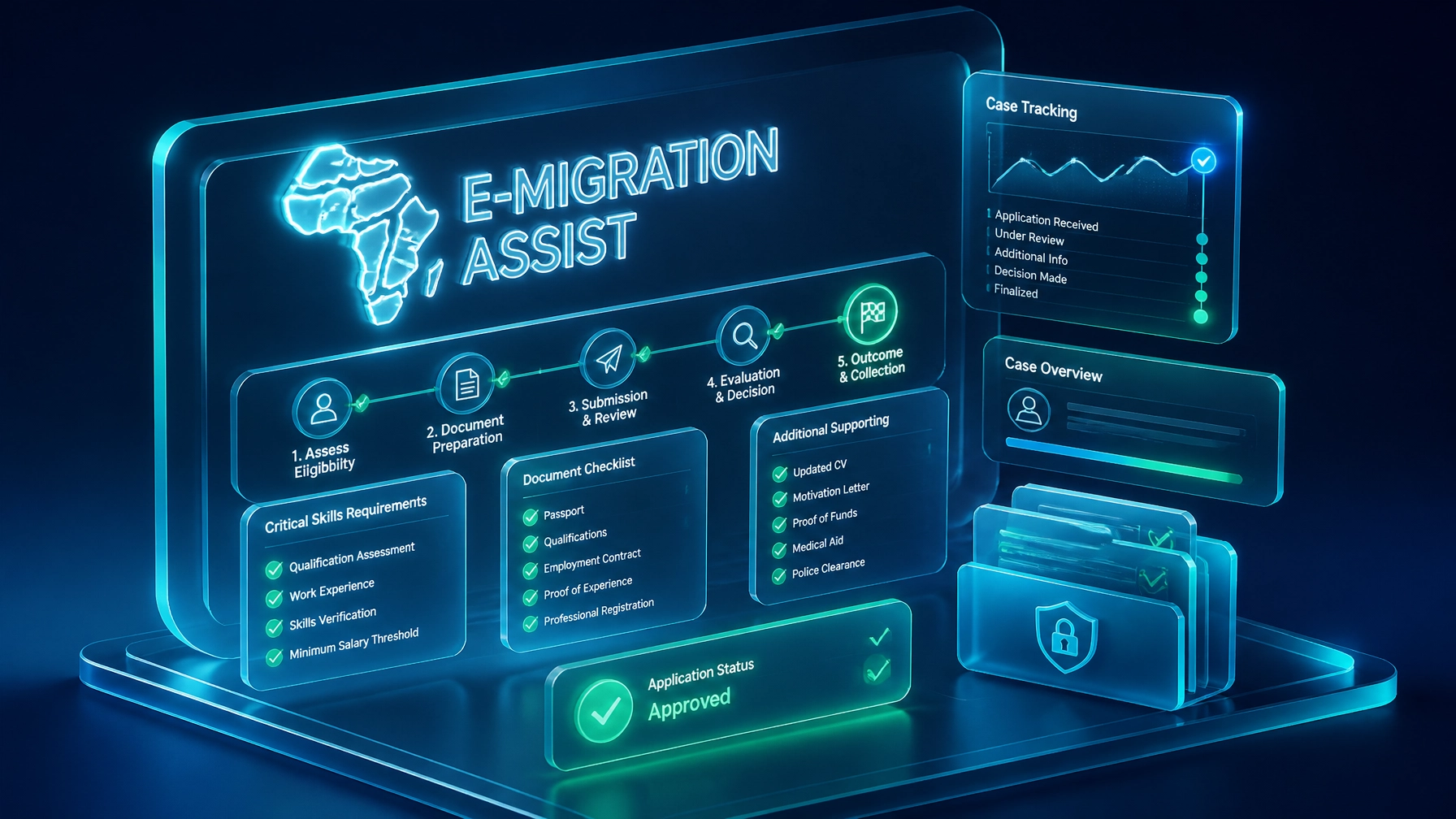
    At E-Migration Assist, we focus on practical control. We replace fragmented admin with guided workflows, secure document handling, and clear tracking.

    Here are seven common mistakes in Critical Skills Visa preparation, and a more structured way to handle each one.


    1. Using the Wrong Occupation Classification

    A common problem starts with role matching. A job title on its own is not enough. The occupation description, duties, and supporting documents all need to line up.

    : The Problem: A role is classified too broadly or mapped to the wrong occupation category. That creates confusion early and weakens the full case.

    • The Solution: Our structured workflows help firms and applicants map the role properly from the start. That gives the case a cleaner legal basis, better document consistency, and more control for mobility teams.

    2. Starting Qualification Review Too Late

    Qualification review is often one of the slower parts of the process. Many applicants wait until a job offer is confirmed before they start.

    A high-fidelity 3D digital illustration of a translucent blue and emerald document pipeline with stacked secure folders, upload arrows, validation checkmarks, and a clean status bar.

    : The Problem: A delayed qualification review can hold up the rest of the file. Medicals, planning dates, and internal timelines can all be pushed out.

    • The Solution: Our Requirements Checklists bring forward high-latency tasks at the start of the case. That helps travellers move earlier, helps legal teams plan better, and helps case managers keep the workflow on schedule.

    3. Missing the Right Professional Registration

    Some occupations require registration with the relevant professional body before the visa file is complete. This step is often misunderstood or left too late.

    : The Problem: The applicant engages the wrong body, or submits before registration is ready. That creates avoidable delays and extra review work.

    • The Solution: E-Migration Assist provides human-reviewed guidance to confirm what type of registration applies to the occupation. That supports a cleaner legal process, reduces back-and-forth, and keeps the case structure intact.

    4. Submitting Weak Experience Evidence

    Employment letters often create problems. They may confirm dates of work but fail to explain duties clearly enough.

    : The Problem: The file contains experience letters that are vague, inconsistent, or not aligned with the role being presented. That can trigger follow-up requests and slow the case down.

    • The Solution: Our system supports document collection in one place and helps standardize supporting evidence. Through our secure document handling portal, firms and applicants can build a more consistent record before submission.

    5. Choosing the Wrong Visa Path

    Not every skilled applicant should follow the same route. A case can become harder than it needs to be when the wrong visa category is selected at the start.

    : The Problem: The case is pushed into a category with extra requirements, unnecessary admin, or a weaker fit for the applicant’s profile.

    • The Solution: Our pre-assessment tools help identify the most practical path based on the applicant’s background and current immigration rules. That improves legal clarity, reduces wasted effort, and gives mobility teams a more reliable process.

    6. Letting Documents Expire Mid-Process

    Some documents only stay valid for a limited time. If timing is not managed carefully, a complete file can become incomplete again.

    A high-fidelity 3D digital illustration of a translucent glass scheduling and validity tracking scene with floating calendar, clock, expiry alerts, and linked case cards.

    : The Problem: Police clearances, medical reports, or related documents are collected too early or submitted too late. That creates rework and delays.

    • The Solution: Our tracking and decision logging system helps monitor document timing across the case. You get better visibility on validity windows, fewer surprises, and more control over submission readiness.

    7. Treating the Case Like a One-Time Form

    A Critical Skills Visa case is not just a form set. It is a sequence of decisions, dependencies, and evidence checks.

    : The Problem: The process is handled manually, with updates spread across inboxes and spreadsheets. That makes it harder to track status, spot gaps, and maintain consistency across the case.

    • The Solution: Our intelligent infrastructure turns the process into a managed workflow. The case becomes easier to review, easier to track, and easier to scale across individual and professional use.

    The New Way: Practical Structure for Better Case Control

    The old way is familiar.

    — Scattered emails.
    — Unclear ownership.
    — Missing documents.
    — Repeated follow-ups.

    It is slow, disorganized, and hard to scale.

    A high-fidelity 3D digital illustration of a centralized legal-tech case management hub with floating dashboard panels, workflow nodes, document archive, and analytics bars in cool glass tones.

    The better way is structured.

    • For global mobility: clearer movement across each case.
    • For legal immigration processes: stronger document consistency and fewer avoidable gaps.
    • For technology and case management: one system for tracking, review, and control.

    Whether you are an individual traveller or a professional firm, the goal is the same: less admin, better structure, and more control.

    Less admin. More control. Clearer case management.

    Take the Next Step

    If you want a more structured way to manage a Critical Skills Visa case, E-Migration Assist gives you a clearer path forward.

    • Start your application: Begin with guided steps, secure document handling, and a workflow built for South Africa immigration. Visit E-Migration Assist for Travellers.
    • Schedule a demo: If you manage cases for clients or employees, see how the platform creates more structure, visibility, and control. Book a platform demo for professionals.

    Take control of your immigration journey with a system designed for less admin, better clarity, and more control.

  • The R100,000 Risk: Why Compliance is Your Only Strategy in 2026

    The R100,000 Risk: Why Compliance is Your Only Strategy in 2026

    In the current South African immigration landscape, the margin for error has disappeared. For immigration practitioners, law firms, and corporate mobility managers, the "old way" of managing visas: relying on spreadsheets, scattered emails, and manual follow-ups: is no longer just inefficient. It is a liability.

    The 2026 regulatory environment has shifted from passive oversight to active enforcement. With the Department of Employment and Labour now deploying 10,000 new inspectors and the Immigration Act imposing R100,000 fines per undocumented worker, compliance is no longer a "best practice." It is the only strategy for survival.

    The Problem: A High-Stakes Enforcement Era

    For years, many organizations operated under a sense of "administrative grace." Backlogs were common, and enforcement was sporadic. That era is over. The Department of Employment and Labour, alongside Home Affairs, has moved toward a "zero-tolerance" framework characterized by aggressive blitz inspections and massive financial penalties.

    : Financial Ruin: Under Section 38 of the Immigration Act, employing an undocumented foreign national now carries a standard fine of up to R100,000 per worker.
    : Aggressive Inspections: 10,000 newly recruited labour inspectors are conducting "door-to-door" workplace audits without prior notice.
    : Criminal Prosecution: Beyond fines, directors and HR managers now face the real risk of criminal charges and imprisonment for non-compliance.
    : The "Undesirable" Ban: Employees found without valid documentation face immediate deportation and a long-term ban, causing massive disruption to business operations.
    : Reputational Damage: A single public non-compliance event can devastate a firm’s standing with clients and international partners.

    Five translucent blue digital folders, each containing organized documents, representing secure document handling.

    The 10,000 Inspector Rollout: No More Hiding Places

    The most significant change in 2026 is the sheer scale of the inspectorate. The government’s move to recruit 10,000 additional inspectors is specifically designed to strengthen enforcement across sectors like hospitality, agriculture, and tech.

    These inspectors are empowered to enter any premises and demand immediate proof of valid documentation for every foreign national on the payroll. For a firm managing 50 or 100 foreign employees, the administrative burden of being "ready" at a moment's notice is overwhelming if you are still using a disorganized, manual system.

    If your documentation is locked in a physical file or buried in an email thread, you have already lost the battle. In an inspection, speed and accuracy are the only tools that provide control.

    The Old Way vs. The New Way

    To navigate this crackdown, professionals must evolve. The contrast between traditional methods and modern, tech-enabled case management is the difference between risk and reliability.

    The Old Way (Manual & Risky) The New Way (Powered & Structured)
    Fragmented emails and local spreadsheets Centralized tracking and decision logging
    Missed expiry dates and renewal deadlines Automated workflows with predefined pathways
    Vulnerable, unencrypted document storage Secure document handling in a privacy-first portal
    Reactive response to blitz inspections Compliance-ready status with 24/7 access
    High administrative stress and confusion Structured clarity and human-reviewed guidance

    The Solution: E-Migration Assist Compliance Infrastructure

    At E-Migration Assist, we have built the specialized infrastructure required to survive: and thrive: in this high-enforcement environment. Our platform is not just a tool; it is a powered foundation that ensures every case is compliant, tracked, and ready for scrutiny.

    + Structured Workflows per Visa Type

    We provide intelligent, predefined pathways for every South African visa category. This ensures consistency across your entire firm and prevents the missed steps that lead to the R100,000 risk.

    + Secure Document Handling

    Our privacy-conscious portal allows for the safe uploading and reviewing of sensitive documentation. In a door-to-door inspection, your proof of compliance is organized, accessible, and ready.

    + Tracking and Decision Logging

    Stop wondering about application statuses. Our system monitors case history and archives results, providing a complete audit trail that satisfies even the most rigorous labour inspector.

    + Professional-Grade Scalability

    Our Professional Firm features are designed for practitioners managing high volumes. Whether you are a corporate mobility manager or a law firm, our platform standardizes complex processes so you can focus on strategy, not admin.

    Transforming Risk into Control

    The current crackdown is designed to penalize the disorganized. When a labour inspector arrives at your door, they are looking for gaps in your process. If you can present a structured, human-reviewed workflow and immediate documentation, the inspection ends quickly. If you can't, the R100,000 meter starts running.

    By moving your practice to E-Migration Assist, you achieve a total transformation:

    • Less Admin: Automated tracking removes the manual "chasing" of documents.
    • More Control: Centralized visibility ensures you are never surprised by an expiry date.
    • Total Confidence: You are ready for any inspection, any time, with a system that mirrors the strict requirements of South African immigration law.

    Secure Your Practice Today

    The cost of non-compliance in 2026 is too high to ignore. Don't wait for a R100,000 fine to realize your manual system is broken.

    Take control of your immigration workflows now.

    Book a Firm Demo or start your Compliance Assessment to see how E-Migration Assist can protect your business and your clients.


    #Hashtags for Social Media

    #SouthAfricaImmigration #ImmigrationCompliance #LegalTech #GlobalMobility #SouthAfricaBusiness #VisaLaw #ImmigrationAct #ComplianceStrategy #EMigrationAssist #WorkVisas #HRCompliance #LabourInspectors #SAImmigration2026